The Earthquake Game


Wow!  Here we were, sitting in section 6, Row 10 seats one and two,  a couple of seasoned baseball fans, ages 41 and 11, taking in the surroundings of Candlestick Park, attending our first World Series game in 1989 between the San Francisco Giants and the Oakland Athletics.  My son, Ryan and I had tickets to the 1987 World Series games scheduled in San Francisco that never happened  A costly error sent the St. Louis Cardinals there instead.

This year, we broke the hearts of Cubs fans, those who had waited longer than us.  No regrets.  Our team, not the Cubs, had advanced to the World Series for the first time since the 1962 San Francisco Giants were defeated by those damn New York Yankees in the last inning of the last game, missing greatness by only a few inches.  The tickets for tonight’s game came via the friend of the mother of a colleague named Steve.  Ironically, it was friends in Los Angeles who “scored” our tickets for this all San Francisco Bay Area World Series.  The seats were great, upper deck, right behind home plate, a bit high, but we could see everything from here.  Due to strange winds, the jets from SFO were using an alternative flight pattern that took them roaring above the stadium, inciting the crowd of 50,000 people, hungry for blood after a 27-year drought.   At 5:00 pm, the players were finishing their warm-ups and national media was beginning to present our anthem to a national audience, sung a capella by local band, Huey Lewis and the News.  Brief eye contact and a quick smile toward each other reassured us that this was going to a memorable night.

Absorbing all the visual and audible images of this moment, I thought back to when I was selected as one of two mandatory eight-year-olds on the Lions youth baseball team in 1956.  I never played but got to sit in the dug-out with the twelve-year-olds and began to develop a passion for the game.  Then, the large book, The History of Baseball, a birthday gift from my parents, taught me everything I needed to know up until 1957.  With the surprising news that the New York Giants, with young star, Willie Mays, were moving to San Francisco for the 1958 season, I was instantly consumed, spending many of my summer days over the next few years, lying around in the yard listening to the game through a transistor radio held to my ears.

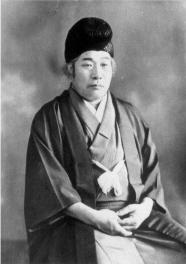
As I do during each memorable baseball experience, I also remembered  Mr. Robert Ishimatsu, our former neighbor and a person responsible for my love of the game.  Amid some neighborhood concern when the Ishimatsu family first moved next door in 1955,  my parents became vocal on the right side of the issue and our families became good friends, me especially with their son, Marty.   Two years later, when I visited Marty in the hospital after he became ill, I fully expected him to come home soon.  He did not, leaving his parents and two young sisters to quietly mourn.

One day, in the early summer of 1958, I had deposited myself on the backyard lawn with transistor radio in hand,  listening to the latest sports news when a soft, clear voice from the other side of the fence, said, “Hey Butch, would you like to go to the game today.”  It was Mr. Ishimatsu.  I was elated.  My transition from radio to a real game was long overdue.   I answered affirmative  and I thanked him until he politely asked me to stop.  Bob Ishimatsu took me to ten or so games over the next few years, all of them great memories, quietly cathartic for both of us.   To this day, I think of him every time I attend a baseball game.

My passion for the game dipped during the ensuing years.  An inability to hit a curve ball rendered it totally a spectator sport and normal distractions in high school and college pushed it back into my subconscious, including meeting and marrying a women who found baseball slow, boring and a temptation to eat junk food, preferring an active soccer match instead.  However, we had two sons together and my suppressed love for the game began to re-emerge.

My wife, Karen and four year-old son Cole stayed home in Los Angeles during this World Series.  Cole was too young to understand, but still a Giants fan in training.  Ryan and I worked together to suppress any influence from his new little friends who would most likely grow up being Dodger fans, something totally intolerable.  Supervising a “play-date” with these new friends,  Karen paused to answer the phone, responding, “Oh, hi Steve, what’s up.”  Hanging up the phone seconds later, she turned on the television and, for the first time in her life, became interested in a baseball game.

The tremor was loud and violent, like an explosion.  At first, it was sheer panic, instinctively reaching to brace myself, totally in the moment.  I reached for Ryan while looking up to see 200-foot light standards waving like the outfield flags.  Surprisingly, my first coherent thought was a recollection that Candlestick Park was built in 1960 on landfill in the San Francisco Bay.  The seemingly endless, muscular vibrations would surely take us down. Then it stopped, everything stopped, for a moment.  There was silence.  Strangely what followed the shaking and the stillness was jubilation.  With San Francisco and Oakland as the competitors, the crowd was mostly Bay Area locals who had lived to tell their past earthquake stories.  The only question was how long the game would be delayed.

Ryan seemed okay, although experiences like this one can linger.  I was still thinking of our vulnerability, sitting atop the saddle of a twenty-nine-year-old stadium built on land that was once water. The fans around us instantly became a community, providing updates, ironically, from transistor radios, the only reliable source of information available at a 1989 baseball game.  For the next hour, the least informed people in the country, regarding this most current event, were the people in the stadium.  At one point, someone shouted that the Bay Bridge had collapsed, later clarified to a section that fell into San Francisco Bay.  Otherwise, local officials were reporting no serious damage or injuries.  I also learned that only the parking lot, not the stadium, was built on landfill and even it did not fall into the bay.

That next thing to occur was the most surrealistic image of the entire experience.  Fifty-thousand baseball fans, calm, patiently waiting for the game to begin, were soon watching chaos on the field.  While the fans were local earthquake veterans, the players, the player’s wives, the New York media broadcasting the game were from various other places throughout the country as well as from Puerto Rico, the Dominican Republic and Venezuela, hotbeds for grooming the game’s future stars.  Uniformed players were hugging their distraught trophy wives or girlfriends, guiding them to safety as they maneuvered their stilettos across manicured turf.  Soon, anyone who was in the catacombs beneath the stadium was on the playing field seeking the safety of open space and local law enforcement officials were responding to what could turn into a significant event.

With no public address system or electricity for the scoreboard, the fans stayed until Huey Lewis exited through the centerfield fence as dozens of police cars entered and surrounded the field.  The game was over before it started.  Soon, after word of mouth from ushers,  disappointed fans stood up and quietly exited the stadium.  We had avoided tragedy, but the night was still young.

After exiting into the parking lot, Ryan and I hovered around an ABC truck that gave us access to the television, covering what we were in the middle of.   We looked up as a small truck, driven by Giants manager Roger Craig, drove by with several players riding in the rear bed, reminding me how Mr. White would transport our team to little league games.  But professional prima donna baseball players, riding in the back of their manager’s truck was not what we had planned to see tonight.   The evening was rapidly moving beyond baseball.

The setting sun injected a new challenge to the situation, darkness.  Tonight, we would not benefit from light of the modern night.  No street lights, no neon, just a glow from the Marina District to the north, becoming visible as we accessed higher ground in our new station wagon.  We were then directed to an alternate route when leaving the stadium.  Expecting to turn right onto the access road to Highway 101, less than a half mile away, we were all forced to turn left and proceed through Hunter’s Point, a neighborhood that had dealt with inadequate street lighting and law enforcement protection for decades.  Soon, we sat in gridlock, in a bad neighborhood during a declared city emergency, the only illumination coming from car headlights,  We were sitting ducks on a pond.

Already feeling uneasy, we began to hear the sounds of breaking glass, Soon, several looters were using baseball bats to shatter store windows, helping themselves to what was inside.   Our worst scenario happened after one of them glanced toward the street and saw targets, unable to run.  First, there was a shattered windshield of the Corvette a few cars ahead of us.   Then, there was another loud and violent explosion.  The rear window of our car was splintered,  our shocked bodies jolted from fear.

For the first time, Ryan’s sounds of distress pushed my adrenaline and anger to the point of giving him bold assurances that no one would enter our car.  Sounding tougher than I was, it was time to find a way out.  Sirens were approaching which would give us some cover and survival instincts seem to be an antidote for traffic congestion.  We were moving again.

We turned left, drove awhile, then turned right because it looked hopeful.  Always boasting of my directional acumen, I had no idea where we were.  Soon, my headlights illuminated a very brave man, standing alone next to a motorcycle, waving his arms off to the right of his body.   “This way,” he yelled. “Turn this way.”   We did, shouting a thanks through our fractured window.  A few hundred feet ahead, the road veered to the left and there it was, a green CalTrans sign that read “San Jose Ave South.”  No longer lost, we would be at our friend’s house in thirty minutes.

Surviving the trauma, we began to feel safe again.  However, after continued assurances of public safety, the radio was now reporting numerous casualties, a collapsed freeway and multiple fires in the Marina District, real tragedies of the day my oldest son and I attended our first World Series game.


The Orchard


As a child, I can remember being awakened by the sound of an irrigation pump, sucking the water from the nearby artesian well to the surface and out to the ditches that I called canals.  I was excited to hear it.  It meant that there was movement in the orchard and things would be changing soon.  The mustard plants were already a few feet tall.  Soon they would be taller than me, providing a bright yellow carpet beneath the prune trees that were blossoming their way out of dormancy.   With the onset of summer, the orchard would become much darker, much cooler from heavy new growth.  This was my first memory of spring, growing up in post WWII Santa Clara Valley.  From my bedroom window, I could look past our new lawn, through a small vacant lot right into the orchard, my personal forest and an ever-changing playground for the kids in this first new neighborhood

Early in Jack London’s “Call of the Wild,” he describes “the sun-kissed Santa Clara Valley” through the image of “an endless array of outhouses, long grape arbors, green pastures, orchards and berry patches.”   This was still true in 1955, even the old portable toilets that seemed to magically appear just before picking season.  My family was among the thousands that pioneered the growth of suburbia in west San Jose, California, proud, at the time, to be called “the second fastest growing city in America.”  My father installed hardwood floors in new homes, start to finish.  He was harvesting a different crop and the bounty was endless.

I was happy.  I had my orchard,  a place to play with my friends, a place to be alone.  Here, I could become Davy Crockett,  the rugged historical character portrayed by actor Fess Parker on the Mickey Mouse Club television program in vivid black and white.  The coonskin cap was a nice touch but the orchard, along with my imagination, brought him to life.  We built forts or formed multiple room apartments in the mustard plants, adding more space when needed by tucking and rolling our bodies to smash the plants down.  I was small, the perfect size for creating a hallway.

Now that the water from the pump was running, Steve, Eddie and I would curb our boredom by challenging each other to stick races in the canals.  Personalized sticks or whatever would float, were placed in the water near the pump for a boost, then we would all run to a place far upstream and wait for the results that were seldom accepted without argument.   Sometimes we would watch the end of a race from one of the large walnuts trees, dispersed among the rows of blossoming, soon to be fruit-bearing, prune trees.

The walnut trees gave us high ground, a look-out and a place to be inconspicuous.   Climbing up first, I had the element of surprise and ammunition, fresh from the tree.  While young, the hard, wrinkly walnut shell is encased in a soft, green, pulpy husk that fit well into a young hand, good for throwing at others, firm enough to sting, but not damage.  The unripened nuts were perfect projectiles and every kid on the block had survived a walnut fight.   Eddie was the smallest but could throw harder than anyone else.   “C’mon, stop,” I yelled, “didn’t you hear me call truce?”  He would eventually stop, reminding me, once again, not to start a walnut fight unless I could finish it.

Periodically we would hear strange music in the distance and rush to climb another walnut tree to listen to the Colonel play bagpipes.   The Colonel was a short, bald European-looking man who, while sitting on a bench under a small arbor, would unknowingly serenaded us with his unusual, haunting melodies.  We always had a perfect spot, we could see him, but he couldn’t see us.  Steve thought that the Colonel had been in the French Foreign Legion, something he thought of anyone with an accent.  “It’s just what I heard,” he scowled, defending himself against our insistence on proof. We should have introduced ourselves to the Colonel and, hopefully, heard some of his stories from the past.  Maybe we would have been disappointed.  He would forever remain a mystery, but the sound from his bagpipes formed a lasting memory.

While the walnut trees gave us so much, they had a way of consistently taking their pound of flesh, mostly in the form of long, deep, hard wood splinters in our hands and feet.  We could push the small ones out by squeezing our skin together, but the deep ones required a quasi-surgical procedure that involved a sometimes sterilized sewing needle, tweezers and my double-teaming parents, one holding me steady while the other performed the extraction.  My father was ex-Marine and a survivor of two battles in the Pacific.  He only knew one way to remove large splinters and each time he would declare, “This is going to hurt, but I will do it as fast as I can.”   It did hurt and always seemed to last longer than it should.  Splinters were an inevitable consequence of life among the walnut trees, but the fun was worth the pain.

One day in 1957, grading equipment appeared and soon a small paved street separated us from the orchard.  They named the street Forest Avenue, which seemed fitting.  It was installed by the city of Santa Clara which meant that we had lived on the undesignated border between the two cities all along.   The short-term pleasure in playing catch with neighbor Billy, each of us standing in a different city, was short-lived.   The graders didn’t leave and our lives were about to change.

Within a few weeks, large trapezoidal mounds of dirt appeared, the tops as wide as a road.  Still not fully comprehending what was happening, we quickly discovered a thrill in running off the top of the mounds to see how far we would sink into the sloping banks.   One time the dirt was above my knees, making it nearly impossible to escape without some tugging from others.  I joked that little Eddie would surely sink all the way up to his neck.  He jumped anyway, flashing me a familiar hand gesture as he thrusted his legs forward, landing on his butt and sliding quickly to the bottom, tearing his jeans.  From a large family, he had younger brothers waiting for those future hand-me-downs, and his mother would not be happy.

Late in the afternoon, the large earth movers were abandoned by the workers and Steve discovered that, without keys, we could still make them lunge forward a few inches simply by pushing the starter button.  We spent nearly an hour taking turns pushing the button until we had moved the behemoth maybe five feet forward.  That was my last memory of playing in the orchard.   Many more graders and other large equipment appeared, much more activity ensued and the reality set in that Forest Avenue would be a connector street for the new neighborhood, hundreds of six-thousand square-foot parcels replacing one orchard.  Less food, more people.   The pride in being recognized as the nation’s second fast fastest growing city came with some harsh physical truths.  In those days, no one protested or chained themselves to a tree.  Growth was progress.  Safely into my ninth year, maybe it was time for me to move on from the orchard.  Besides, Davy Crockett didn’t make it.  His battles were over.

Everybody went about their business as the new neighborhood progressed from sticks to walls.  Coming upon a fallen walnut tree made me briefly sad and nostalgic, but, for the most part, our lives didn’t change.  Some of the prune trees, those not in the way, were spared to help sell homes.  Buy a house, gain a free fruit tree.  Our orchard had become a sacrificial lamb to the American Dream.

Each spring revealed fewer blossoms.  The beauty of Jack London’s Santa Clara Valley could now mostly be found on postcards.  The new neighborhood unveiled scattered prune plum blossoms, but was now focused on the large production of a new crop that would later be called “baby-boomers.”  At first, they were nicknamed the “orchard kids,” but we welcomed our new friends as seamlessly as we said goodbye to the orchard.  Newbies Cindy, Paul, Budd, Tim, the Long sisters and others integrated with Steve, Eddie, Susan, Jill and Glen from the old gang.  As we progressed through adolescence, it became one community with hardly a memory of what once was.

My sister, born in 1965, grew up, then raised her daughters in that old house, all without any reality of my treasured playground.  A few years ago, I was talking to my youngest niece about the way things once were and she asked, “Where was that orchard you were talking about?”  Getting into the car on our way to the mall, I pointed across Forest Avenue toward the aging homes and  answered,  “Right there.”

Things that never exist to some, survive in the minds of others.


A Garden Of Earthly Delights


It’s near, I can tell by the way the approaching hallway was quickly filling up with people as I walked through.  Hopefully, the crowds won’t be a distraction.  Knowing that I would be spending some days in Madrid in 2012, I made it a point to come to the Musee de Prado to view, among other pieces,  artist Hieronymous Bosch’s, “The Garden of Earthly Delights,”  the controversial 15th Century triptych that formed a college research project and began a lifetime passion for the arts and natural beauty in general.  As my eyes quickly brushed across the piece, left to right, I noticed an attractive, middle-aged woman, her brown eyes also fixated on Bosch’s bold images.

The left panel has been described as depicting Creation,  the serenity and beauty of its namesake forming a blissful scene while God introduces Eve to Adam.  In the large central panel, the artist begins to question our morality with scenes of increasing vice and unheeded warnings of future danger.  Chaos begins to emerge, presented theoretically with images, such as a man struggling to carry a large mussel shell partially encasing naked bodies, a curious metaphor.    Having done some research on the painting, I would have loved to spend an evening with Bosch, picking his fresh brain on details, after he completed the work in 1510.

The Garden of Eathly Delights

The Garden of Eathly Delights

The right panel is clearly Hell and Damnation, represented in an abstractly modern way, a fantasy of grotesque images, even by today’s standards.  We see musical instruments inflicting torture while a large rabbit carries a human corpse on the end of its spear.  Then, there he is, hiding behind some gnarled skeletal remains, Bosch, in self portrait, observing the carnage, looking unsurprised and expressionless.

As the crowd began to dissipate, my mysterious compatriot moved in for a closer look as did I.  Finally approaching her and, putting my hand on her shoulder, I whispered into her ear,  “This may sound corny, but I have observed this painting twice in my life, 43 years apart and, both times, the same woman was standing next to me.”   Smiling, my wife responded,  “I don’t think its corny, it’s kind of romantic.  Forty-three years doesn’t seem like much after looking at this.   And, before I forget,”  she continued,  We must see “Guernica” before we leave, it’s here in Madrid somewhere.”  “Guernica” is a famous Pablo Picasso abstract painting depicting the horror and aftermath of the bombing of a small village in northern Spain by Nazi and Italian planes.  Picasso had controversially submitted it as his contribution to the Spanish Exposition at the 1937 World’s Fair in Paris.  We had learned more about the painting at the Picasso Museum in Barcelona and Karen had already labeled it a “must see.”

"Guernica" by Pablo Picasso

“Guernica” by Pablo Picasso

Since that day in 1969, when we both, as undergraduate students, traveled to the DeYoung Museum in San Francisco and selected a piece of art to research for my final paper, our passion  began to grow into what has been has become a major part of our lives over the past 47 years.  Together, we have seen Monet’s “Water Lilies” at the Musee’ de L’Orangerie in Paris,  Chagall’s stained glass “Windows” at the Art Institute of Chicago, Cristo’s “Umbrellas,” Richard Serra’s 100 meter long “Snake” at the Guggenheim Museum in Bilbao, James Turrell’s evening exhibit at the Chichu Museum on Japan’s Naoshima Island and the Impressionists at the d’Orsey, always an aphrodisiac, enhanced during our last trip by a small room on Rue Clare and a cheap bottle of French wine.

The month of April 2012 in Spain was extraordinarily wet.  It was raining, days later when, after visiting “Guernica” at the Reina Sofia Museum, we boarded a train and left Madrid for parts south, Granada, Alhambra and Sevilla.  We were also bound for a cave that Karen had researched, located somewhere near the base of the Andalucia Mountains, containing art of a more primitive form.  She justified her desire to see the Pileta Cave by reminding me that we had a car reserved in Ronda and that we could visit the famous white hill towns nearby.

Karen had done most of the research for our 28-day journey, but the itinerary fluctuated as she immersed herself into each experience that generated new “must sees.”  Our normal paradigm is that I am initially reluctant to her changes and later, as men do, boast about them as if they were always my idea.  This experience was no different as we were about to discover more than Andalucia’s hill towns.

Most images of old Spain are based in Andalucia.  It is the home of bullfights, flamenco, gazpacho and, to our discovery, breathtakingly majestic landscapes and ancient history.  In Ronda, rain pushed us into a taxi from the train station to the hotel.  Curiosity and the need to walk sent us out in the rain, staring directly at Spain’s oldest bullring as we exited out into the street.  A hotel clerk directed us to turn left and keep walking until we came to Plaza de Espana and the new bridge. I am always entertained by the Old World’s  interpretation of time and this “Puente Nuevo”  project dated back to 1751, back when they made them like they used to.  As I asked for clarification, the clerk responded with very good, broken  English, “Don’t worry, you will know it when you see it.”

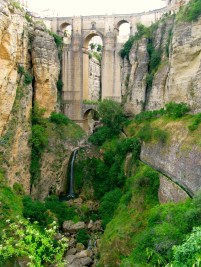
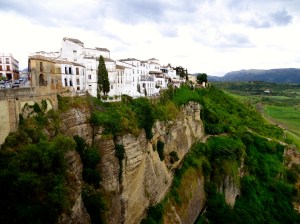
The walk down to the plaza was pleasant, but unremarkable.   Aside from the old bullfights and being the home of Ernest Hemingway, Ronda was a very charming city, but we anticipated that the true scenic drama would come from the white hill towns at hand.  Walking across the plain stone surface of the plaza, Karen, approached the railing first, looking out across at the bridge and softly muttered, “OK, this is pretty spectacular.”   I turned, responding to her and it appeared, a view so breathtaking, so unforeseen, that fresh words were not necessary. Continuing to stare in silence,  we could not have imagined that this unassuming bridge would span, bothRonda, Spain vertically and horizontally, the gorge locals called “El Tajo,” 400 feet deep, 200 feet wide, connecting us to La Cuidad, the old Moorish district, its ancient structures perched along the cliffs on the other side of the chasm.    As we continued to explore with a new adrenaline rush,  more staggering cliffs appeared and it was soon clear that Ronda was the most magical hill town in Andalucia.

Our month in Spain had left us with enduring memories but these cliffs, “El Tajo” with its bridge and the ancient structures were majestic, as awe-inspiring as the recent visual images by Picasso, Goya, Bosch and others.  Gaudi’s Sagrada Familia in Barcelona and Gehry’s Guggenheim in Bilbao were magnificent, but did not overpower the striking natural beauty of Ronda.   Without much discussion, I realized that this was another “Garden of Earthly Delights” moment.  We had, again, "El Tajo"discovered something together that moved us, two very visual people, sharing a moment, locking in a memory.  This rainy afternoon in Ronda was mesmerizing, leaving us wanting more, but we had a “Ford something” reserved the next day and alluring places to be.  Both of us knew that we had not finished exploring Ronda.

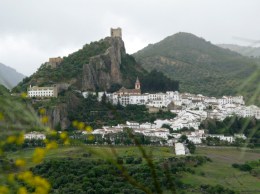
The early morning rain made the white-knuckled drive over the steep and winding Cadiz Mountain pass the most quiet of our trip.  Healthy fear always trumps complaints of one’s driving or navigating.  More relaxed to be driving on the gently winding valley road, we soon approached the cozy village of Grazalema with its whitewashed buildings, red roofs and bright floral window boxes.  The extraordinary picturesque town,  Zahara, with white buildings spread out below an old fortified Moorish castle and the cliffs, simmering from the afternoon sun in Arcos were truly indelible images, a consistent theme of

Zahara, Spain

Zahara, Spain

Andalucia.   The evening return to Ronda on a two-lane highway was dry and flat, stimulating more conversation than the unnerving morning jaunt over the mountain.  We discussed our schedule for the next few days but it was difficult for me to think beyond wanting  to explore “El Tajo.”

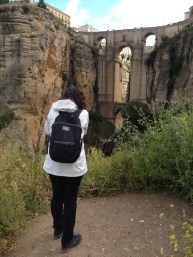
We started early and the sun was shining.  Crossing the bridge and stealing yet another glance at the gorge, we entered La Cuidad seeking trail access to descend its walls. Passing the old building entrances that innocently faced the street, it is difficult to imagine that they are resting directly upon the top of the cliffs.   “I think this is it,” Karen proclaimed as a small path dissecting two structures appeared.  We followed it and soon were descending down into “El Tajo” with a perspective that seemed to reshape itself with every step.  The surrounding flora changed, the deeper we plunged.  The gorge became a series of unique ecosystems complete with waterfalls, blue ponds and green foliage, rooted in the rocky cliffs.  Our desires to photograph kept us mostly to ourselves but the experience was and will be forever ours.

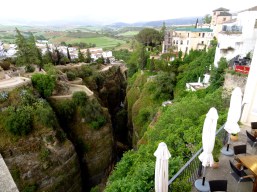
The walk back up the canyon was equally stupendous, ending with a late lunch in one of those buildings roosted atop the cliffs with a view of the bridge.  It began to rain again and, feeling a bit overwhelmed, I suggested that we

Panoramic of Ronda

Panoramic of Ronda

forgo the Pileta Cave.  With a challenge disguised as an option, Karen replied, “You can do what you want, but I’m going to see what’s in there.”   Soon, I was making the somewhat unpleasant, dark, damp and slippery descent into a cave to view prehistoric finger painting, depicting animals and fish, evidence that the artists were familiar with the sea.  The experience was beyond description and, once again, I was appreciative of the spousalIMG_0391 nudge.

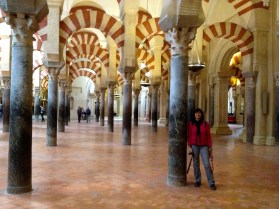
We left Ronda by train, vowing to return.  Although our next few days would be spent in Sevilla, Karen had made arrangements to debark the train for a few hours in Cordoba so that we could visit the Mezquita, an ancient temple with both Moorish and

Karen at the Mezquita in Cordoba, Spain

Karen at the Mezquita in Cordoba, Spain

Christian influences.  Our time in Ronda and the Andalucia was still very much on my mind.  The experience, days after we revisited a significant piece of art in our lives, was a reminder that there are vast earthly delights to explore and, more significantly,  that we still had the passion to find them.


The Many Faces of Grenache


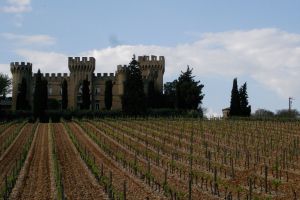
The grenache grape is many things to many wines.  It is one of the most prolifically planted grapes in the world, a dominant component in some of the most famous blends, yet, individually, it is shy, content to support other grapes in famous blends from the Rhone Valley in southern France, the Rioja region in northern Spain and the “GSM” blends from southern Australia.  It is diverse, known as granacha in Spain, cannonau on the island of

Vineyard in Chateaunef-du-Pape

Vineyard in Chateaunef-du-Pape

Sardinia and grenache in France, each proclaiming it as their own. In fact, for centuries, all of these regions were under the Crown of Aragon which my research shows began in the 10th Century with the marriage of Petronilla of Aragon and Ramon Bereguer of Barcelona.

By the 14th and 15th Centuries, the Crown of Aragon controlled regions of Catalonia (northern Spain), Athens (Greece),Majorca (Spain), Provence (southern France), Naples, Sardinia, Sicily (Italy) and others. With plantings of grenache dating back that far, it is probable that the proliferation of plantings happened during this time period.  It seems that Petronilla and Ramon shared the wealth.  Simply put, grenache was born on both sides of the Pyreness Mountains where it is still grown abundantly today.

Best from low yield vines, grenache is berry-flavored, mostly strawberry and raspberry, peppery, soft on the palate and produces wine with a high alcohol content.  It also lacks acid, tannins and color which is why it most often blended with other varietals that can support its deficiencies. Although, grenache is the most dominant varietal in eighty-percent of the blends from the Chateaunef-du-Pape appellation in southern France, known throughout as one of the world’s best.  In all the southern Rhone Valley appellations, grenache, syrah and mourvedre, sometimes with support from cinsault and counnoise are blended to form, arguably, the finest wines on the planet, with apologies to Burgundy, Bordeaux, Tuscany and California.

E. Guigal is a notable wine producer in the Rhone Valley whose releases range from value to collectible wines and are accessible to the U.Sconsumer.  For those interested in experiencing a good Rhone blend, the grenache dominant 2010 E Guigal Chateaunef-du-Pape($40)is

E. Guigal Chateaunef-du-Papa

available on-line and at many wine shops.  This wine had lengthy bottle aging prior to release and received ratings in the mid-nineties from Wine Spectator and Robert Parker.

In South Australia, grenache is abundantly planted and is, again, a major player in their “GSM” blends or, as I refer to them, Rhone blends on steroids.  The heat and overall warmer climate in the southern hemisphere enhances the fruit flavors of grenache, syrah, mourvedre and Spain’s tempranillo.  The Aussies even call their syrah by a different name to accentuate the difference in styles.  The new name, shiraz, has a flamboyancy that fits its persona.  An Australian “GSM” blend is, generally, a soft, fruit-forward, accessible wine to enjoy with friends, but the more austere Rhone Valley wines are by far the best to pair with food.  One of the San Francisco Bay Area’s top restaurants, Sonoma’s, “The Girl and the Fig,” has an extensive wine list, all from the Rhone Valley.

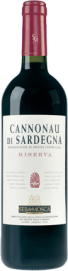
In Spain, granacha is the common varietal that is blended with tempranillo to create those popular and acclaimed wines from the Rioja region, south of Bilbao.  Cannonau wine from Sardinia is available for very reasonable prices.  Years ago I had to opportunity to taste a vintage of the Cannonau di Sardegna ($16), a wine that Robert Parker proclaimed one of the world’s best wines under $25, and my memory is of floral,

Cannonau de Sardegna from Sardinia

Cannonau de Sardegna from Sardinia

perfumed aromas and a lighter texture.

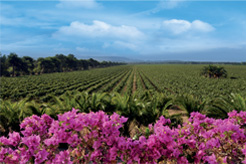
In California, Rhone Rangers from Paso Robles, the Santa Ynez Valley and other regions are using grenache to produce the best blends outside of the Rhone Valley.  Paso Robles wineries like Linne Colado, Terry Hoague and Tablas Creek produce excellent

Vineyard on the island of Sardinia

Vineyard on the island of Sardinia

blends, using grenache, in varying degrees, as the dominant grape.  The best Rhone blend in California and, possibly the planet comes from west Paso Robles’ Saxum Winery.

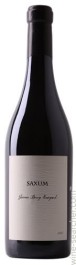
Among other highly touted Rhone blends, Justin and Heather Smith have produced a grenache dominant blend for the past ten years that has given them great reviews and notoriety.  Wine Spectator magazine, after placing the 2006 Saxum “Broken Stones”($45/96pt) twelfth of the 2009 list, awarded the rich and layered 2007 Saxum James Berry Vineyard ($68) blend a 98-point rating, naming it their 2010 Wine of the Year. I treat myself to a few bottles of Saxum releases each year and the consistent quality is extraordinary, as good as any blend from Chateaunef-du-Pape.  In addition to the James Berry Vineyards, Saxum produces

Saxum James Berry Vineyard blend

Saxum James Berry Vineyard blend

two other blends:  “Bone Rock” and “Broken Stones,” also exceptional, but there is a downside.  With the accolades, Saxum wines have become difficult to acquire and now cost nearly $100 per bottle.

The signature of many California wineries is releasing single-varietal wines, including grenache.  It has emerged from several regions of the state, but mostly from the Santa Ynez Valley in Santa Barbara County, Paso Robles, Calaveras County in the gold country and Monterey County.

From one of Paso Robles’ most distinguished producers, The 2013 Adelaida Grenache Anna’s vineyard ($36) is a personal favorite.  I have tasted several vintages of this wine and it alway has classic aromas of strawberry and spice, adding black cherry flavors.

Just blocks off the main square, in an old train depot, the local family owned Anglim Winery produces a variety of wines including the 2012 Anglim Grenache Willow Creek District ($38), boasting wild strawberry on the nose and palate.

Bonny Doon Cellars is a leader in producing California Rhone blends and, has recently added some very fine vineyard designate

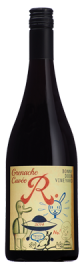
2012 Bonny Doon Cuvee' "R" Grenache

2012 Bonny Doon Cuvee’ “R” Grenache

syrah, mourvedre and three all grenache releases from vineyards in Monterey County, all currently in my cellar.  With a 92-point rating, Planet Grape described the 2014 Bonny Doon Grenache Cuvee’“R” ($48) as “pure, expressive, old-vine grenache.” The newly released, limited production 2014 Bonny Doon Grenache ($24) is a nicely balanced wine that was born to accompany grilled seafood like ahi tuna or salmon.  Detailed as a “food and wallet friendly” wine, each vintage, including the 2014 Bonny Doon “Clos du Gilroy” Grenache ($20), with small amounts of syrah and mourvedre added, is consistently listed as a top value wine.

2014 Bonny Doon Grenache

2014 Bonny Doon Grenache

The success of  Santa Ynez Valley’s production of quality grenache releases prompted a “Grenache Wars” event in Los Angeles last year, pitting their wines against Paso Robles releases intended to promote the varietal that has had limited respect over the years. Among the best include the 2010 Tercero Grenache Larner Vineyard ($35)from the Ballard Canyon area near Solvang and the 2012 Jaffurs Grenache ($34), a well rated, supple wine made from grapes in three area vineyards.

Several years ago, I had an opportunity to walk with Ampelos Cellars owner/winemaker Peter Work through his organic/biodynamic Ampelos Vineyard in the renowned Santa Rita Hills appellation near Lompoc.  A rare varietal in this region, the 2012 Ampelos Santa Rita Hills Grenache-Delta ($37) is an exceptional wine that benefits from its extended growing period, great soil and 33 months aging in the barrel.

2012 Jaffurs Grenache Santa Ynez Valley

2012 Jaffurs Grenache Santa Ynez Valley

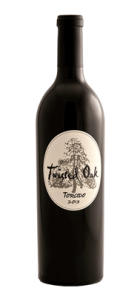
A lesser known region, Calaveras County has been producing high quality wines for decades, including many Rhone varietals.  I am familiar with two grenache releases from this area that represent very  distinctive styles.  Each year, Twisted Oak Winery, near Angels Camp produces a 100% granacha and the recent 2013 Twisted Oak “Torcido” Granacha ($37) is a bold wine with dark ruby colors that pairs well with meats like spicy sausage.  Grapes from the Dalton Vineyard in San Andreas are sourced for the 2013 Val du Vino “Giselle” Grenache Dalton Vineyard ($27), a lighter wine that pairs well with turkey. Offering Rhone and other varietals at the tasting room in Murphys, CA, I first discovered Val du Vino wines at a private winemakers dinner, hosted by owner/winemakers Jonathan Phillips and Jeannine Hebel, a renowned French chef.

2013 Twisted Oak "Torcido"

2013 Twisted Oak “Torcido”

Grenache is everywhere, a major part of the masterfully woven Rhone blends, the well-aged wines from Rioja, the fruit-forward “GSM” blends from South Australia, the fragrance of cannonau and California, where it is pushed in many different directions.  Its expressions of fruit and spice are always evident but never overbearing.  Grenache has withstood the test of time and continues to prove its worthiness as one of the world’s most significant wine grapes.


Wine Pairing Challenge


Pairing wines with a special dinner is challenging, but fun, especially when it supports a good grassroots cause.  Having lived in the coastal community of Pacifica, south of San Francisco in the early seventies, we still have DSCN4282friends there, many of whom are involved in a long-standing  non-profit organization called “Pacificans Care.”  Made up of all volunteers, the group raises funds to support various projects that enhance the city, aesthetically and culturally.  Participating in a wine pairing dinner to support them seemed like a worthy endeavor.

When I was informed that the chefs would be serving a herbed pork tenderloin as one of the courses, several wonderful pairings came to mind.  Depending on sauces and other ingredients, pork tenderloin can be complimentary to a range of varietals, from chardonnay to syrah.

However, this menu flavor profile was so diverse that it made selecting the wine difficult.  For example, the pork tenderloins were wrapped in prosciotto inviting a medium-bodied pinot noir or bolder syrah, but was served with an apple chutney that would normally favor a chardonnay.  With any challenge comes an opportunity to be

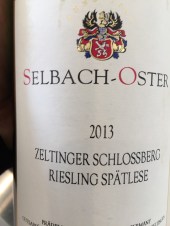
2013 Selbach-Oster Zeltlinger Schlossberg Riesling Spatlese

2013 Selbach-Oster Zeltlinger Schlossberg Riesling Spatlese

creative, to do something unexpected, then hope that it all works.  Let’s review what we chose and why.

Appetizers

Cheeses:  Garrotxa (Spain) raw goat’s milk

                    Raclette (Switzerland) cow’s milk

Wine:        2013 Selbach Oster Zeitinger Schlossberg Riesling Spatlese    

                    Mosel (Germany)

Asked to select an introductory wine paired with cheese, we settled on an all European pairing that began with a highly rated, rich 2013 Selbach Oster Zeltlinger Schlossberg Riesling Spatlese from the Mosel region of Germany. A style of German riesling, Spatlese, translated, means “late harvest” but cannot be confused with our late harvest sweet dessert wines.

Garrotxa

Garrotxa

Among the styles of German riesling, Kabinett is more austere, less fruit forward, pairing well with food, Spatlese is more rich and creamy with a soft minerality and Auslese can be compared to our later harvest dessert wines.  The medium-bodied Selbach Spatlese came to my attention when Wine Spectator magazine rated it 93-points, citing complex flavors of red peach, apple pear and anise.  I felt that the rich minerality and petrol nuances of the wine helped express the creamy Garrotxa from northern Spain and Raclette, the national cheese of Switzerland

1st Course:  Cream of Mushroom Soup, Creme Fraiche, Parmesan

                         Crisps     

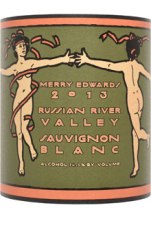
 Wine:            2013 Merry Edwards Sauvignon Blanc (Russian River Valley)

Creme fraiche, a French cultured cream available at most  markets, adds richness to soups and sauces. In this instance I anticipated enhancement to a soup that was already creamy. Needing to avoid  rich, buttery

2013 Merry Edwards Sauvignon Blanc Russian River Valley

2013 Merry Edwards Sauvignon Blanc Russian River Valley

chardonnay or other acidic white wines, this was actually are easiest choice.

The Merry Edwards Sauvignon Blanc from the Russian River Valley in Sonoma County is, arguably, one of the good food wines ever produced.  The flavors of the 2013 vintage, fairly austere not to compete with the richness of the soup, still express white peach, pear, citrus and melon on the palate preceded by floral aromas.  Awarded 93 points by Wine Spectator magazine, this sauvignon blanc is a “foodies” dream and was a perfect pair with our first course.

2nd Course:  Shaved Fennel and Herb Salad with Baby Radishes

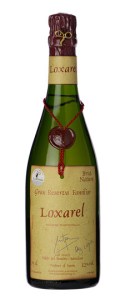
Wine:   2009 Can Mayol Loxarel “Gran Reserva de Familia” Brut

               Nature Penedes (Spain)


This pairing definitely took some “risk-taking” and was, without a doubt, the evenings most unique. Although a sparkling wine, this is not a Spanish cava produced in the “methode champenoise” because there is no dosage.  Dosage, pronounced with the accent on the second syllable, is a sweet mixture of wine and sucrose added, in small measure, to each bottle designed to enhance the flavor. French champagne, Italian proscecco, Spanish cava and other sparkling wines made in the “methode champenoise” have dosage.  Those with none are known as “brut nature” wines and generally have a more herbal flavor profile that compliments food.

The 2009 Can Mayol Loxarel “Gran Reserva de Familia” Brut Nature originates from the Penedes region, south of Barcelona, which is the oldest wine region in Europe. It consists of Xarel-lo grapes, common to the sparkling and still wines from Penedes and is aged 51 months on its lees, using the dead yeast to add texture.

2009 Can Mayol Loxeral "Gran Reserva"

2009 Can Mayol Loxeral “Gran Reserva”

In awarding this wine 93-points, Robert Parker described fennel as one of its flavors which was enough for me to take a chance on the pairing.  Our guests were a little surprised at the choice of a sparkling wine, expecting champagne flavors, but the “brut nature” complimented rather than overpowering the salad.

Although this 2009 vintage was the oldest wine we served, it was recently released, six years after harvest.  This is an extraordinary amount of time in comparison to wines produced in the states, that age 20-24 months.  European wine maker’s comfort with extended aging is primarily based on financial reasons. Most European wineries have been family owned for centuries whereas those in the states commonly are owned by the bank and the pressure to get the product to market is higher.

3rd Course:  Herbed Pork Tenderloins, Apple Chutney, Honey-Roasted Carrots

                          with Tahini Yogurt, Potato Stacks

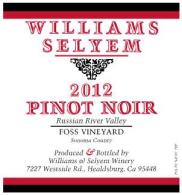
Wine:              2012 Williams Selyem “Foss Vineyard” Pinot Noir RRV

Pork pairs well with a range of wine varietals depending how it is prepared.  This specific recipe was difficult because the pork tenderloins were wrapped with prosciotto, favoring syrah or other deep red varietals, but the apple chutney and honey roasted carrots would prefer a rich California chardonnay.  I settled for a specific medium-bodied pinot noir from the Russian River Valley in Sonoma County that, hopefully, would balance this complexity.

2012 Williams Selyem Pinot Noir "Foss Vineyard" Russian River Valley

2012 Williams Selyem Pinot Noir “Foss Vineyard” Russian River Valley

Williams Selyem is one of the state’s finest producer of Burgundian-style pinot noir and cool-climate chardonnay.  They have estate vineyards, but mostly source grapes from some of the finest vineyards in the Russian River Valley and beyond.  The nearby west-facing Foss Vineyard benefits from afternoon sun after the morning fog has lifted which results in some of the warmest soils in the valley, allowing the grapes to fully ripen for bolder flavors.

The elegant flavors of pinot noir can pair with complex flavors, including prosciotto and chutney if it also has rich texture and solid structure such as the 2012 Williams Selyem “Foss Vineyard” Pinot Noir RRV or equally fine releases from wineries such as Roar in the Santa Lucia Highlands and Loring Wines in the Santa Rita Hills appellation.


Dessert:  Bittersweet Chocolate Truffle Cake

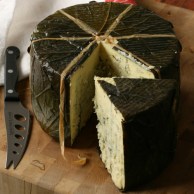
                   Rogue River Blue (Oregon) with sage honey

Wine:       2007 Val du Vino “Opportunity” (Amador County)

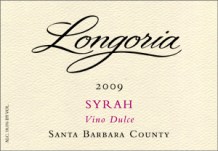
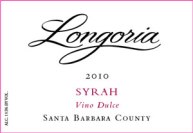
                   2009 Longoria Syrah Port (Santa Ynez Valley)

Dessert was the easiest pair of the evening, adding my favorite Rogue River Blue from southern Oregon with sage honey as an option to the chef’s wonderful truffle cake.  Rogue River Blue has a rich and creamy texture that lacks the bite of most blue cheeses and is always a good dessert alternative.  It is exclusively a fall cheese and I had

Rogue River Blue

Rogue River Blue

some difficulty finding it in March.  After some effort, I finally was able to purchased some through a unique online gourmet cheese source call amazon.com.

Our two aged port-style dessert wines spanned California regions, from Amador County in the North to Santa Ynez Valley in the South.  Personal favorites, the 2007 Val du Vino “Opportunity” is a true port, sourced

2009 Longoria "Vino Dulce" Syrah Port

2009 Longoria “Vino Dulce” Syrah Port

from Amador and aged eight years in French oak and the Longoria “Vino Dulce” Syrah Port from Santa Ynez Valley both express rich flavors of dark berries, spices of vanilla and pepper and, of course, chocolate.  They can and did pair equally well with the chocolate and the cheese.

Everyone had fun, a good cause was supported and we all discovered more about the wonderful partnership of food and wine.


Ancient Vines Of Limerick

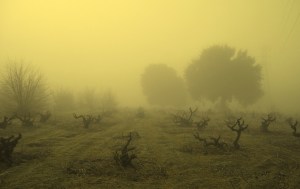
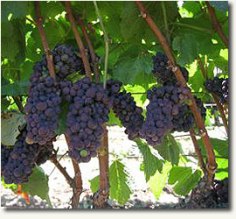
Oakley_ghost_vineyard

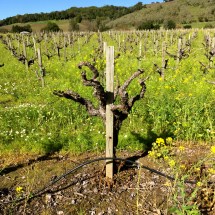
Ancient vines in Oakley, CA

“Old Vines” or “Ancient Vines” is an uncommon designation, often synonymous with rich wines with great texture and character.  Aside from some “old vine” designates in the Rhone Valley in France, the overwhelmingly vast majority appear in California with the zinfandel varietal.

Most research shows that vines of popular varietals like chardonnay, cabernet sauvignon and sauvignon blanc have a life span of approximately 50 years and the terroir, rather than the age of the vines, is what translates into quality.  However, leave no doubt that the ancient California zinfandel vines uniquely translate into a higher standard.

The distinct life of a zinfandel vine goes through several decade-long productive transitions until reaching maturity in 70-80 years.  This is when they begin to produce dramatically lower yields which as we know, equates to heavily concentrated flavors and overall high caliber wines.  We see this with many varietals during times of

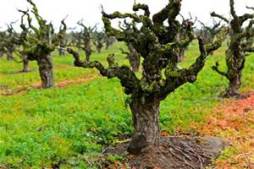
Gnarly "Old Vines"

Gnarly “Old Vines”

destructive weather impacts such as a late frost when the damaged grapes must be sacrificed for the good of the others.  In these years, volume and profits are low but, as many wine makers have told me, it’s the time to submit wines for critical review.  With zinfandel vines, reduced yield, or lower tonnage, occurs naturally, appealing to those consumers who prefer big, luscious zinfandel releases and are willing to pay a premium price.

Ancient vines are as physically identifiable as the rich flavors they produce. In dormancy, they are thick and gnarly, looking like headless ogres waving their

Limerick Lane estate vineyard

Limerick Lane estate vineyard

arms in all directions, otherwise appearing lifeless.  They become more majestic in late spring, serving as a strong foundation for what is proportionally, moderate leaf and fruit growth.

France, Germany, Australia and other countries boast “ancient vines,” but old California zinfandel vines, from Sonoma County, Napa Valley, Lodi and Paso Robles afford us the opportunity, firsthand, to experience what the excitement is all about.

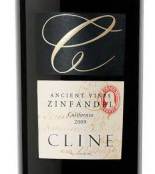
Cline Cellars produces a series of reasonably priced  “ancient vine” wines from their Oakley vineyards in Contra Costa County, first planted over a Century ago by Italian and Portuguese immigrants.  Among many consistent vintages, the 2013 Cline Ancient Vines Zinfandel Contra Costa County ($20) adds a combined 10% of petit sirah,

Cline "Ancient Vines" Zinfandel

Cline “Ancient Vines” Zinfandel

carignane and syrah to the blend that delivers ripe fruit flavors and a creamy mouthfeel.  Used primarily to add structure and texture to the Rhone Valley blends in France, the 2013 Cline Ancient Vines Mourvedre Contra Costa County ($22) is a rare solo release with hints of chocolate and a luscious deep plum flavor.  Equally rare, the 2013 Cline Ancient Vines Carignane Contra Costa County ($23) adds a degree of spice to the rich flavors.

The iconic Napa Valley Rombauer Vineyards produces old vine zinfandel from a historic vineyard in the Sierra Foothills of Amador County.  The 2012 Rombauer “Fiddletown” Zinfandel ($43) comes from Gino Rinaldi’s 100+ year-old vineyard, located some 1,800 feet above sea level, producing very low yields and a wine both intense and complex.

For observing “ancient vines,” I recommend a drive along the Valley of the Moon Highway, connecting Sonoma with Santa Rosa, north of San Francisco.  A gorgeous site during any season, but the late winter vines, interspersed with yellow mustard plants, using the Mayacama Mountains as a backdrop, are breathtaking.  Tasting the fruits of these vines is available at a plethora of valley wineries along the road including Landmark Cellars and Ledson Winery.

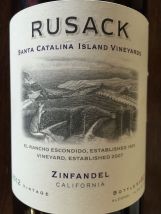
The classic ancient vine zinfandel story comes from Geoffrey and Alison Wrigley Rusack of Rusack Vineyards in

Rusack Zinfandel Santa Catalina Island

Rusack Zinfandel Santa Catalina Island

the Ballard Canyon area of the Santa Ynez Valley, north of Santa Barbara.  Geoffrey received permission to explore and excavate cuttings from some ancient vines discovered on Santa Cruz Island off the coast of Ventura.  The University of California, Davis confirmed that the vines were zinfandel, most likely left by missionaries over a century ago.  The zinfandel vines have been re-planted on Santa Catalina, another of the Channel Islands, as part of Rusack’s Santa Catalina Island program that includes pinot noir and chardonnay.  Having recently enjoyed the rare 2012 Rusack Santa Catalina Island Zinfandel ($72)), these ancient vines certainly delivered a rich texture and complex flavor profile that will continue to improve with age.

LIMERICK LANE CELLARS

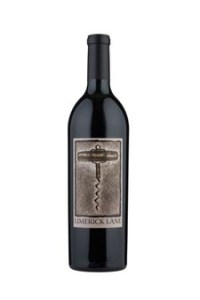
My recent curiosity in “old vine” or “ancient vine” zinfandel was peaked when a small, little known Sonoma County winery with vineyards adjacent to the Redwood Highway, south of Healdsburg placed their vintage 2012 Limerick Lane Zinfandel Russian River Valley (94-pt/$32) in the #12 spot

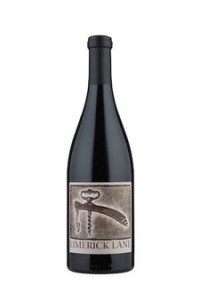
Limerick Lane Zinfandel Russian River Valley

Limerick Lane Zinfandel Russian River Valley

on Wine Spectator’s Top 100 wines of 2015.  A very high ranking of a zinfandel from a local winery within 10 miles of my home led me to investigate further.

The year 1910 was when the Del Fava family planted the oldest vineyard on the property in the northeastern Russian River Valley.  They saw potential in this site that has less fog and considerably warmer soils.  The family owned and farmed the original vineyards for over 65 years, sourcing grapes to many wineries before they sold it in 1977 to locals, Michael and Tom Collins.

The Collins operated the small winery on Limerick Lane for 34 years, making significant strides to improve the property, including the new dry-farmed, 25-acre Collins Vineyard, directly across the road.  Also, during their stewardship, the Limerick Lane Cellars label was created to produce estate wines.

When the Collins brothers decided to sell the winery in 2011, they rejected any corporate interest, handpicking local Jake Bilbro and his brother Scot as the best team to maintain the small family operation that had been productive over the past 101 years.  After some preliminary challenges, the sale was consummated and the Bilbro brothers sought out on a journey through Limerick’s most recent evolution.  We sought to taste some of their new 2013 vintages following up on the 2012 estate zinfandel that put them on the map.

With some mourvedre and petit sirah to provide complexity, the most high production 2013 Limerick Lane Zinfandel Russian River Valley ($36), with 1,900 cases, had a chalky, earth element, nice minerality and luscious mouthfeel, a good value.

From the original ancient plantings,the 2013 Limerick Lane “1910 Block” Zinfandel ($48) has a distinct

Limerick Lane Syrah/Grenache

Limerick Lane Syrah/Grenache

herbal nose with concentrated fruit flavors and a smooth, balanced finish.  Combining Rhone varietals, the 2103 Limerick Lane Syrah/Grenache ($36) offer healthy spice in the bouquet and does not disappoint mid-palate with berry pie, pepper flavors and evident tannins.

We finished the tasting with two very small production releases, one highly rated and another resulting from a unique process.

With 94-point ratings from both Wine Spectator and Robert Parker, the 2013 Limerick Lane “Head-pruned Block” Syrah ($48) is a full=bodied syrah with a fragrant bouquet and intricate white pepper, plum and blackberry on the palate with balanced tannins throughout.

Clearly the most unique wine of the day, the 2013 Limerick Lane “Hail Mary” Syrah ($48)uses carbonic maceration, where whole cluster grapes are fermented in a carbon dioxide-rich setting, to create complex flavors and soft

Limerick Lane "Hail Mary" Syrah

Limerick Lane “Hail Mary” Syrah

mouthfeel.  Grapes, leaves and stems are placed in open top stainless steel tanks, layered with dry ice and gently walked on every few days.  With the exception of those on the bottom, the grapes are not crushed, oddly leaving the skins intact during fermentation.

Initially, the “Hail Mary,” with 94% syrah and 6% grenache, displays a beautiful deep ruby color, then earth and candied fruit on the nose followed by rich flavors and silky tannins.  This is the one I took home.

Producing quality juice for more than a Century, it took that 2012 vintage “old vine”zinfandel to uncover Limerick Lane’s wonderful wines and their story of handwork and commitment to the land.  All of the wines we tasted had high character and, although cost is relative to our personal budgets, all current releases are a value at their price.  This and the other small boutique wineries on Limerick Lane are definitely worth exploring on an afternoon.


As for these mature zinfandel and other varietals, look for the “ancient vine” or “old vine” designations on the labels of wines at all levels.  Your research will assure more expression of fruit and a softer texture in the glass.


Lyle’s Totally Subjective TopTen Films of 2015


More so these days, I’m not on the same page as the Oscar nomination process; money doesn’t always equate to standard.  Nonetheless, it was a good year for film and many on my list were frequently mentioned throughout the awards season.  One exception is the German film, “Phoenix,” a gripping story of a woman, a disfigured concentration camp survivor, recovering from physical wounds and dealing with a new appearance, love and

"Phoenix"

“Phoenix”

betrayal, and my choice as best film of 2015.

#1:  Phoenix (Christian Petzold)

Nelly Lenz, a former Jewish singer, is coping with deep physical and emotional scars as a concentration camp survivor, ones that require complete changes to her facial structure and appearance.  Longing for her lost husband, she is told that he is still alive but betrayed her to the Nazi’s to gain his freedom and, assuming she is dead, is trying to gain access to her sizable inheritance. Still in love and in denial of her husbands intentions, she seeks him out working in a small bar, “Phoenix” and is quickly drawn into his plot. Nelly, artfully played by actress Nina Hoss, seems to be on an emotional roller coaster until, in my opinion, the most compelling final scene of any film I watched in 2015.

#2:  “Room” (Lenny Abrahamson)

"Room"

“Room”

One of this year’s most moving films, “Room” tells the story of a young woman dealing with raising a son while imprisoned, first in a 10” X 10” shed and then by the post rescue emotional scars that changed her life forever.  The success of the film required excellent performances by Brie Larson and 9-year old Jacob Tremblay and they both delivered.  Larson’s character was courageous, devoted, creative and resilient, moving a difficult theme into a compelling film. Joan Allen delivered a very real performance as a mother dealing with loss and the painful side of discovery. Although it seems very dark, it is a very inspirational film that leaves you feeling good.

#3:  “Spotlight” (Tom McCarthy)

A timely subject and a great ensemble cast including Michael Keaton, Mark Ruffalo, Rachel McAdams and Liev Schreiber, “Spotlight” tells the gripping true story of a small group of investigative reporters from the Boston

"Spotlight"

“Spotlight”

Globe who broke the story of sexual abuse within the Catholic church.  The style of the film is reminiscent of “All The President’s Men” as we see, up close, the personal edge of a story that first rocked a community, then the world. McAdams, following a successful role in the TV mini-series, “True Detective,” delivers a stand-out performance that should get some consideration for an Academy Award. 

#4:  “Youth” (Paolo Sorrentino)

Paolo Sorrentino’s delightfully abstract film, “Youth,” one that may require several

"Youth"

“Youth”

viewings, is nuanced with age and reflection as well as a reminder that new, good, important things are not always wasted on the youth.  An astonishing ensemble of actors, including Michael Caine, Harvey Keitel, Rachael Weisz, Jane Fonda and Paul Dano, along with alluringly creative cinematography made this an engaging, yet fun film of 2015.  Ask me about it after I’ve seen it again…and again.

#5:  “The Revenant” (Alejando Gonzalez Inarritu)

One of the true stars of “The Revenant” is Glenn Ennis, who played the infamous bear.  Dressed in “blue screen blue,” Ennis studied the aggressive moves of the bear and his

"The Revenant"

“The Revernant”

wrestling match with Leonardo DiCaprio became the memorable scene of the film.  Of course the bear head and fur where digitally added later. Director Alejando Inarritu is on fire, DiCaprio and Tom Hardy add excellent performances as we journey into the dark, cruel realism of the American frontier, a study of one that returns.

#6: “Mustang” (Denize Gamze Erguven)

On the last day of school, some innocent play with boys at the beach leads to unnecessary

"Mustang"

“Mustang”

scandal and the lives of four sisters are forever changed.  “Mustang,” from Turkish-French director, Denize Gamze Erguven, is a film about oppression of young women, so common in parts of the world, told through the story of four sisters, living in northern Turkey.  Gossip and ignorance create fear of the potential family disgrace in not being able to present the girl as a virgin while arranging her marriage, something that is verified by a doctor before the contract is complete.  Much of the story is seen through the youngest daughter who observes new bars on windows, school replaced with traditional homemaking skills and her older sisters married off, some to strangers.  The film explores oppression and freedom and should be seen by as many people as possible.

#7: “The Danish Girl” (Tom Hopper)

Although Eddie Redmayne mastered another complex role and Alicia Vikander brings one of the years best

performances as artist Gerda Wegener, the true majesty of “The Danish Girl” is the stunning cinematography,

"The Danish Girl"

“The Danish Girl”

transporting the viewer into an art piece.  What began as an evening’s game leads to Einar permanently assuming a female persona named Lili, an onerous journey in the 1920s.  Vikander’s character displays the full gamet of emotion, from anguish to denial to support and unconditional love. Her performance carries the beautiful film and is worthy of Oscar consideration.

#8: “Ex Machina” (Alex Gordon)

Imagine you are a coder for the world’s largest internet company and chosen to spend a

"Ex Machina"

“Ex Machina”

week with the company’s recluse CEO at an extremely remote (very cool) location where you interact with an AI robot, played by the stunning Alicia Vikander.  “Ex Machina” is filled with intelligent dialogue and certainly has one of the most intriguing plots of the year.  Alicia Vikander has such a strong presence on-screen that you understand she is a robot,but can still be mesmerized. This film is best defined by the tagline:  “There is nothing more human than the will to survive.”

#9: “Irrational Man” (Woody Allen)

Woody’s latest foray into the primal instincts of man leads to a bizarre epiphany for a disillusioned and hopelessly depressed college professor seamlessly played by disillusioned and hopelessly depressed Joaquin

"Irrational Man"

“Irrational Man”

Phoenix. His actions and the chaos that follows ironically serves as “Prozac” for the professor who re-discovers his “inner mojo” and begins to turn his life around.  Everything is great except for one or maybe two little things that must be taken care of.  Emma Stone seems to be comfortable with Woody’s style and shines on-screen, while Parker Posey’s performance as a sex-starved chemistry professor,  metaphorically, plays a major role in Phoenix’s ups and downs.

#10: “Bridge of Spies” (Steven Spielberg)

As a 12-year old, I remember when the news reported that the Russians had shot down an American U2 spy plane

"Bridges of Spies"

“Bridges of Spies”

and captured pilot, Francis Gary Powers.  However, the details were more recently revealed in the latest Spielberg/Hanks collaborative docudrama about a successful insurance attorney who was recruited to represent arrested Russian spy, Rudolf Abel, superbly played by Oscar nominee, Mark Rylance, who has been arrested for espionage.  After the Power’s capture, Hank’s role evolves from legal representation to negotiating a delicate prisoner exchange.  No explosions or gun fights, just a well told visual story.


Wine and the Millennials


Jug wine, including those that come in a box, is officially on the endangered list, thanks, in no small part, to young adults, surrounding thirty, affectionately known as “Millennials,” the offspring of maturing Baby Boomers.

pic_vyd_pisoni2A recent study by Rob McMillan, from Silicon Valley Bank wine division, predicts the unthinkable, the first decline in wine consumption per capita in 20 years, attributed, in part, to a steady decline in sales of high-volume, budget table wine.  Correspondingly, the industry has enjoyed an increase of sales in the $10-25 market and they recognize the trend toward high-end, boutique wines as they prepare to ride the wave of the Millennials, 80 million strong, for the next 30 years.

On a weekly basis I am reading of acquisitions of smaller, high-end wineries by larger corporations.  Beringer Wine Estate recently purchased the esteemed Gary Farrell Winery, a fine pinot noir producer in the Russian River Valley, E&J Gallo, our nation’s largest producer, now owns multiple boutique wineries in the Healdsburg

"Millennials

“Millennials

area, a trend expanding throughout California.

Likewise, Heineken International is now a 50% partner with the Petaluma-based Laguinitas Brewing Co., among the fastest growing boutique breweries, valued a $1 billion.

The larger corporations are not interested in inquiring new vineyards, they are investing in the high-end future, one that will be dictated by the “Millennials” discerning palates and thirst for nice things.  Technology is also connecting this new generation to European wines, with apps providing unprecedented access to research on new vintages.

So, for those “Millennials” or anyone from twenty-one to ninety, let me offer some recommendations for quality wines of character, $20 or less, that could be fine additions to any cellar. Although I list some wines by their current vintage, they are consistently good, year to year.  Prices do vary and the one listed is the lowest that I could find.

2014 Bonny Doon “Clos de Gilroy” Grenache ($20)

As a long-standing member of Bonny Doon’s Distinguished Esoteric Wine Network, I am familiar with and often recommend this wine as a great value.  It has been described by winemaker/founder Randall Grahm as “The wine

Bonny Doon "Clos de Gilroy" Grenache

Bonny Doon “Clos de Gilroy” Grenache

formerly know as Clos De Gilroy” because it now sources grapes from Monterey County and the Sacramento Delta, adding some syrah and mourvedre for extra flavor and structure.  It expresses “jammy” fruit flavors of raspberry and cherry combined with white pepper and herbs. Prepare yourself for a screw top bottle, a change that Grahm made for all his wines years ago, claiming more reliability in maintaining freshness.

Those preferring white wines will also enjoy the 2014 Bonny Doon “The Heart Has Its Rieslings” ($13), both sweet and tart with a nicely balanced acidity and a

Bonny Doon "The Heart Has Its Riesling"

Bonny Doon “The Heart Has Its Riesling”

very fun label.

2014 Seghesio Sonoma County Zinfandel ($20)

There are some good choices among value-priced zinfandel, none better than Seghesio’s Sonoma County Zinfandel.  Most of their releases fall into the $35-50 price range, but this wine, from vineyards in Sonoma’a warmest regions, is no stranger to critical acclaim. Be prepared for a food-friendly “fruit bomb” with rich, blueberry flavors, 14.8% alcohol and a nice hint of black pepper.

I recently enjoyed a glass of the 2013 vintage with grilled salmon and found the soft, perfumed bouquet with

Seghesio Sonoma County Zinfandel

Seghesio Sonoma County Zinfandel

young, but luscious flavors a suitable pair. Fairly accessible, I have seen other vintages of this wine at local outlets, wine wholesalers and online.

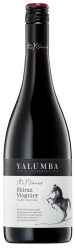
Yalumba Y Series Shiraz-Viognier ($13)

Yalumba Y Series Viognier ($13)

Yalumba, south Australia’s oldest family winery, produces a plethora of red and white wines that are all good values, none better than the Y Series Shiraz-Viognier with very interesting aromas, ripe, velvety cherries and the signature Aussie touch of adding a bit of viognier for taste.  The Y Series Viognier has significant citrus on the nose and palate with a soft, rich texture from

2014 Yalumba Y Series Shiraz-Viognier

2014 Yalumba Y Series Shiraz-Viognier

aging “sur lie.”

Once familiar with the Yalumba label, I have seen it in local wine outlets and high end markets.

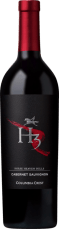
2013 Columbia Crest “H3” Horse Heaven Hills Cabernet Sauvignon ($12-15)

Washington State’s Columbia Crest has been producing high quality, mid-priced wines for decades and their “H3” Series highlights the vineyards within the Horse Heaven Hills appellation in eastern Washington.  I have not tried this wine as yet, but it has been rated as a “Best Buy” with ratings in the 90s by Wine Spectator and Wine Enthusiast magazines. With full malolactic fermentation, the reviews speak of rich, layered flavors with a bit of cocoa on the finish

Columbia Crest "H3" Cabernet Sauvignon

Columbia Crest “H3” Cabernet Sauvignon

Columbia Crest wines are readily accessible at many local wine outlets, markets and membership stores.  However, their “H3” Series wines, especially one with these reviews, may require some research online.

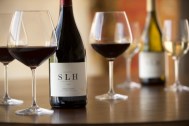
2013 Hahn Estates Santa Lucia Highlands Pinot Noir ($20-25)

The Santa Lucia Highlands appellation in Monterey County has become the source of much of the state’e finest pinot noir in this decade. Producers of fine pinot noir from Sonoma to Santa Barbara County are securing grapes from the “Highlands” for their consistent quality and reputation.  Hahn Winery has had a presence in the California wine industry for several years and their 2013 Hahn Estates Santa Lucia Highlands Pinot Noir has received high accolades from all the major

Hahn Estates SLH Pinot Noir

Hahn Estates SLH Pinot Noir

reviewers, describing its floral nose, highly dense, layered flavors and a strong finish, all qualities of a nice pinot noir.

The “perfect storm” of this quality/price ratio has rendered this wine a bit rare, but I did find stock at K&L wines.

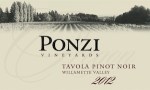
2014 Ponzi “Tavola” Willamette Valley Pinot Noir

Ponzi Winery is a staple among Oregon’s Willamette Valley, focusing primarily on

2012 Ponzi "Tavola" Pinot Noir Willamette Valley

2012 Ponzi “Tavola” Pinot Noir Willamette Valley

pinot noir and chardonnay.  Their premium pinot noir, vintage to vintage, earns high praises and commands  a lofty price tag.  However, the 2014 Ponzi “Tavola”  Willamette Valley Pinot Noir ($20), their introduction to the “heartbreak” varietal, has the attention of many wine critics, named by many periodicals as one of the best values-priced pinots with grapes sourced from 11 different sustainable vineyards.  For a young wine, it is very aromatic and expresses pleasantly rich flavors.

I have seen this wine online at multiple prices.  The best price was at K&L Wines, that also has outlets in Hollywood and San Francisco.

Barrel 27 “Right Hand Man” Syrah ($20-25)

Barrel 27 “High On The Hog” White Rhone Blend ($14-18)

For good wines within the $20 or less level, I always recommend a range of varietals from Barrel 27 Winery in Paso Robles.  A highly rated vintage of their “High On The Hog” classic Rhone blend of grenache, viognier,

Barrel 27 "Right Hand Man" Central Coast Syrah

Barrel 27 “Right Hand Man” Central Coast Syrah

roussanne and marsanne first led me to Barrel 27.  Vintage to vintage, this wine has always delivered rich, creamy texture and flavors with a nice minerality on the finish.

All of Barrel 27 red wines are good values, but the “Right Hand Man” Syrah, sourced from vineyards in Paso Robles, the Arroyo Grande Valley and Santa Ynez Valley, is typically balanced with significant aromas and accessible soft, rich flavors.  These wines are both available in wine outlets and online, but the best place to acquire  them is their Paso Robles tasting room.

A very deserving quick mention Lincourt Winery in Santa Ynez Valley and Buehler Winery in Sonoma/Napa Counties as resources for consistently good value releases and the readily available Greg Norman Cabernet-Merlot ($15) is always a good option.

So all current, parents or grandparents of Millennials, start building your cellar of “good value” wines that maintain the high standards we all deserve.  Be aware, this may lead to bigger and better things.


Wine and Cheese Pairing, 2016


The idea began with our desire to support “ArtStart,” a local Santa Rosa non-profit that provides opportunities for high school student artists to create and install public art projects.  Our solution was to donate to the auction a wine and cheese pairing for 14 people.  After a successful $1,500 donation, it was now time to create a

The Wines

The Wines

memorable experience that exceeded the donors expectations.  As always, the wine selections would be easier than determining and acquiring the proper cheeses.  Even living in Sonoma County where many fine artisan wine and cheeses are produced, research to find unique pairings would require some effort.

To facilitate the outcomes to 1)discover the aromas and flavors of each wine and cheese, 2)understand their backstory and 3) promote discussion and select favorites, we distributed comments from winemakers and sommeliers that assisted us through “power of suggestion.”  Seven bottles opened, seven cheeses unwrapped, we were ready to start the global culinary journey.


Pairing #1:  Old World vs New World Chenin Blanc

Chenin blanc, originating from the Loire Valley in France, is one of the most versatile wines in the world,

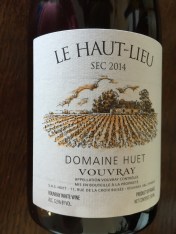
2014 Huet Le Haut-Leiu Vovray Sec

comfortable as a dry, semi-dry, sparkling or dessert wine.  Grown extensively in South Africa, Australia and California, the grape has made a huge comeback over the past few decades. We compared the waxy richness and minerality of the 2013 Williams Selyem Chenin Blanc, grown in San Benito County and fermented in concrete eggs at the Russian River Valley winery with the rich 2014 Huet Le

Williams Selyem Chenin Blanc 2012 San Benito County

Williams Selyem Chenin Blanc 2012 San Benito County

Haut-Leiu Vouvray Sec, a classic semi-dry from France with stone fruit flavors throughout the finish.  No favorites here as the group decided that the two wines were different but equal, experiencing the diversity of the grape.

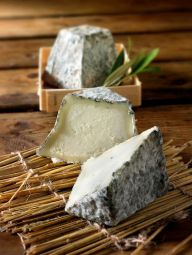
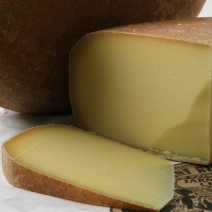
The two wines were paired with Valencay (Val-on-say), a tangy goat cheese from central France and a

Valencay

Valencay

young Mahon from the island of Minorca in Spain, both salty with an appealing creamy, nutty flavor.  Young, as opposed to aged Mahon (mah-ON), is an accessible semi-soft cheese that becomes hard with distinct salt crystals as it ages.  Surrounded by the Mediterranean Sea, locals explain that even the grass and cow’s milk from the island is salty.  My usual preference is for the young Mahon, but the citric tanginess of the of the Valencay, rare to the US, was a unique new discovery for all.

Pairing #2:  “California Chardonnay and Spanish Goat Cheese”

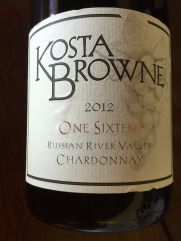
Sonoma County’s Kosta Browne Winery consistently creates, arguably, the best pinot noir in California, earning Wine of the Year status from Wine Spectator magazine with their 2011 Kosta Browne Pinot Noir Sonoma Coast.  The winery has recently begun producing a rich, Burgundian-style chardonnay from the Russian River Valley that epitomizes their high

2012 Kosta Browne "116" Chardonnay Russian River Valley

2012 Kosta Browne “116” Chardonnay Russian River Valley

standards.  This pairing features the 2012 Kosta Browne Chardonnay “116” RRV, named after the highway that meanders through the Sonoma Valley, that combines nice aromas of lemon, pears and toast with stone fruits and lemon curd flavors and a lingering mineral finish. To augment these flavors, we chose a pasteurized goat cheese from northeastern Spain.

Garrotxa

Garrotxa

Garrotxa (gah-ROW-cha), an area in the Catalonia region, north of Barcelona, is home to a collective of goat farmers, many of whom fled urban life to revive the local cheese making trade. The semi-aged, semi-soft cheese has a somewhat sweet, nutty flavor with hints of cooked milk.  We used the rich texture of the wine to compliment the buttery sweetness of the cheese to create a celebration on the palate.


Pairing #3:  “All-American Classic”

One of this country’s most awarded cheeses, Pleasant Ridge Reserve from Uplands Farms in Wisconsin won Best Of Show by the American

2013 WALT Pinot Noir "The Corners" Anderson Valley

2013 WALT Pinot Noir “The Corners” Anderson Valley

Cheese Society in 2001, 2003 and 2010, the only cheese to do so. After careful consideration of pairing this creamy, nutty, caramel flavored cow’s milk cheese with the Kosta Browne Chardonnay, we opted for the earthy 2013 WALT Pinot Noir “The Corners” Anderson Valley, knowing from experience that they would compliment each other perfectly. From the northerly Mendocino County, WALT is owned by the Napa Valley’s Hall Wines team and responsible for the production of their pinot noir releases. This 2013 vintage, awarded 92-pt by James Laube from Wine Spectator magazine, has a floral, clove bouquet with a rich, vibrant cherry-cola flavor that lingers throughout the finish.

Pleasant Ridge Reserve

Pleasant Ridge Reserve

A rare raw cow’s milk cheese in the US, the Pleasant Ridge Reserve comes from a single herd and only from the pasture season, beginning in late spring through the fall.  The evenings most creamy, well-integrated cheese with a young, but luscious pinot noir release was an instant hit with our guests and stood out as the best pairing.


Pairing #4: “The Island Pairing”

Geoffrey and Allison Wrigley Rusack have, for decades, produced quality wines in the Ballard Canyon area of the Santa Ynez Valley, near Solvang.  Through Allison’s family connections, they gained access to five acres on the old Rancho Escondido site on the island where they began, in 2010,

2012 Rusack Zinfandel Santa Catalina Island

2012 Rusack Zinfandel Santa Catalina Island

producing pinot noir, chardonnay and a half acre of a very special varietal.  Geoffrey received permission to excavate some cuttings from ancient vines on Santa Cruz Island, another of the Channnel Islands.  Analysis determined that they were old zinfandel vines, later transplanted to the Rancho Escondido site.

Having an opportunity to secure one bottle of each varietal annually, the scents of cranberries and old leather foreshadowed the youthful maturity of the 2013 Rusack Zinfandel Santa Catalina Island (Bottle #827), fruit-forward with a complex flavor profile strong enough to compliment aged Mahon (mah-ON),

young Mahon, aged Mahon

young Mahon, aged Mahon

a hard, textural cheese, salty with toasted nuts and caramel flavors that thoroughly coat the palate, pairing best with a rich, deep flavored wine like zinfandel.


Pairing #5:  “Nearly French”

Randall Grahm, founder/winemaker at Bonny Doon Vineyards, is one of the patriarchs of the California Rhone Rangers, replicating the famous blends from Chateaunef-du-pape in France’s southern Rhone Valley.  The

2010 Bonny Doon Le Cigare Volant Reserve

2010 Bonny Doon Le Cigare Volant Reserve

syrah/grenache dominant 2010 Bonny Doon Le Cigare Volant Reserve en bonbonne, is a rich, savory red blend with deep berry and tobacco aromas followed by herbal flavors and a long, silky finish.  Awarded 92-pt by Wine Enthusiast magazine, it is uniquely aged in 5-gallon glass bottles, the same ones from yesterday’s water coolers.  The right cheese to compliment this wine was never in question.

From France’s Basque region near the Pyrenees Mountains, the semi-soft Ossau-Iraty (OH-so ear-ah-TEE), a very wine compatible sheep’s cheese, has complex brown butter, caramel flavors that seem to soften deep

Ossau-Iraty

Ossau-Iraty

flavored wines like syrah, especially one as earthy and savory as the Le Cigare Volant.


Pairing #6:  “Dessert!”

The last and sweet pairing of the evening featured a 2010 Longoria Syrah Port “Vino Dulce” from Santa Ynez Valley with the creamy, buttery Rogue River Blue

Rogue River Blue

Rogue River Blue

from southern Oregon’s Rogue Creamery.  The port-style wine, available in Longoria’s Los Olivos tasting room expressing cherry, vanilla and spice flavors, is often served with chocolate desserts but the Rogue River, lacking the aggressive bite of most blue’s and augmented by sage honey, was a memorable compliment to the wine and the experience.

Of course, there were no winner or losers, just some of the world’s finest cheeses carefully matched with fine wines, a culinary delight beyond reproach.  Many of these cheeses are available at various gourmet markets, often providing personalized assistance with selections.  As a

2010 Longoria Syrah "Vino Dulce" Santa Barbara County

2010 Longoria Syrah “Vino Dulce” Santa Barbara County

backup, there are many reliable websites that can offer the most rarest of cheeses.  I also often consult food columnist Janet Fletcher’s “Cheese and Wine – A Guide to Selecting, Pairing and Enjoying” and “Cheese Course” by Fiona Beckett as resources for our pairings.


The Art That Is Japan


Among many, my most lasting memory of Japan are the gardens.  The breathtaking palaces and temples and the most humble country dwellings all share beautiful

Gardens in Kyoto

Gardens in Kyoto

manicured gardens, some larger, some smaller, but always perfect.  These winsome gems, like so much of the traditional Japanese culture stems from a conviction to “respect” and “honor.”  It is evident in the way they revere the land, their high regard for guests or hosts and in their meticulous approach to traditional Japanese arts as the basis of their heart and culture.  Our Japan experience was not about visiting Tokyo and other major tourists sites, it evolved from a rare opportunity to attend a two-week seminar in traditional Japanese arts at the Oomoto Foundation and School in the town of Kameoka, outside of Kyoto.

Banshoden Prayer Hall, Oomoto

Banshoden Prayer Hall, Oomoto

Friend and Sonoma County artist Mario Uribe has studied Japanese culture along with his wife, Liz, for the past twenty years.  Both were participants in past Oomoto seminars.  After years of excluding visitors from the program, Oomoto granted Mario permission to work with the school in developing an arts study seminar for 15 people themed “Sei” or “Purity.”  Weeks later, we found our impulsive selves flying over the Pacific with no real idea of what lie ahead.

Oomoto is a sect, originating from the Shinto religion, that was founded in 1892 when Deguchi Nao, an impoverished, illiterate woman had a “spirit dream” and began writing and reciting the words of the spirit Ushitora no Conjoin that formed their doctrine

Onisaburo Deguchi

Onisaburo Deguchi

. Nao’s son-in-law, Onisaburo Deguchi is recognized as the original seishi (spiritual teacher) of Oomoto and was responsible for the core belief that the practice of Japanese traditional arts together could create a deep spiritual wisdom for all.  Abandoning the traditional focus of mastering a single art, Onisaburo advocated practicing all the art forms, taking advantage of commonalities to create something holistically greater.  Today, under the 5th spiritual leader, Kurenai Deguchi, students and other followers attend the Oomoto School and Ayabe retreat center to enhance their spiritual development through traditional arts.

Afternoon arrival at the island Kansai International Airport and the ensuing bus ride to Kameoka left us with only time to check-in, have dinner, unpack and place futons on tatami floor mats, our bed for the next two weeks.   The first day was fairly relaxing at an on-site Kan’O Chakai Festival where we attended a noh drama performance and tea ceremony, foreshadowing the work ahead.

The next two weeks would be as exhausting as they were rewarding, exemplifying the phases, “Out of one’s comfort zone”

Serious students

Serious students

and “Information overload.”  Understanding is the key to studying a new culture and, only when I began to discover the values they reveal and their importance to the Japanese way of life did I begin to immerse myself into the various traditional arts, understanding my limitations.

Each day began at 5am with chanting, broadcast into our rooms, a reminder that we had an hour before our morning Shinto prayer service at Banshoden Hall.  The service, of course, is optional but we felt it enhanced the experience to attend each morning.

Entering the grounds to the prayer hall began with a bow from the waste, followed by a short walk to the temizuya, a decorative water fountain with bamboo ladles used to cleanse hands and mouth.  Shoes came off and another bow was required entering the prayer hall, women to the left, men to the right.  The prayer service is the same each day, participatory readings, chanting and rhythmic hand clapping designed to gain the attention of the gods.

After prayer came breakfast and later lunch, consisting of a small amount each of protein and vegetable with all the rice

temizuya

temizuya

and miso soup you can eat. The Japanese diet is seafood based with much smaller portions than we are used to.  At times, I was happy for more rice and miso soup.  In case you are wondering, we had many gourmet meals that, although different and new to the palate, were outstanding.

The morning session generally began with dressing in kimono which was a fairly complex procedure that often required assistance. It is disrespectful to even practice the sacred arts of noh drama, tea ceremony or waraku budo without men and women both wearing kimono. Mostly, practice times coincided but when they didn’t, it was a long day in the wardrobe room.  Once the practice session were over, the kimono and undergarments must be folded in a very specific, traditional method. Admittingly, as someone who is used to throwing on  jeans and a t-shirt, this process required some patience and skill.

Traditional Japanese Arts

A 16th Century poet, Yoshida Kenko wrote that, “The moon is most beautiful when seen through clouds.”  Noh Drama, said to be “the world’s oldest continuously performed tradition of theater,” is an art form that uses illusion and subtle, yet precise movements and song to tell a story.  Common to other traditional Japanese art forms, its simplicity takes a lifetime to master.  We were privileged to study, over six sessions, with Tatsumi Manjiro Sensei, Lead Character Actor of the

Noh Drama performance

Noh Drama performance

Hosho School of Noh Drama, one of the traditional schools dating back to the 16th Century.  At over six-feet tall with the voice of James Earl Jones, Manjiro Sensei was quite intimidating as we watched him effortlessly glide, not walk, across the stage.  His humor and patience with us was humbly appreciated.

Group I, Michael, Miles, Daniel and me, after extensive practice,  performed the first act (3 minutes) of the story of a poor, street sake vendor who, through living a good life and caring for others, was divinely blessed with a continuously full barrel of saké. Learning to glide, not walk, in a kimono with precise, expressive movements and with a fan acting as a saké ladle requires more practice and muscle memory that time permitted, but we got through it.

Perceived simply as a traditional way to entertain guests, my discovery that Tea Ceremony is, in fact “moving meditation” woven into the Japanese culture, from the Zen temples of Kyoto to current day, was a major takeaway from the seminar.  As a 40-year “steep and sip” guy, it took some time to begin to understand the formality of it all.  I have a friend who has studied Tea Ceremony twice per month for 20 years. I recently met her instructor, asking the question, “How long does it take.”  “A lifetime” was her answer.

IMG_4852

“Michiko”

Tea Ceremony has always been associated with the Zen philosophy and is truly an art form that allows a host to create a

“microcosm of paradise” for their guests. Simple, but elegant tea rooms are designed to create a pure, quiet, harmonious space. We were invited to several very special tea rooms and each space, while unique, seemed always to relax us.

A teahouse is entered without shoes and on one’s knees.  After bowing, the guest spends time respecting and admiring a scroll, some of them valuable antiques, others quite simple, but always present.  After admiring the scroll, each guest gives a brief glance to the chabana, a small, minimalistic, somewhat insignificance flower arrangement that is essential to any tea room.

We studied otemae, the art of preparing the tea, learned the intricate process of hosting or receiving the tea as a guest including the precise folding of the silk fukusa cloth, used to purify the utensils and the practice of admiring (respecting) the tea bowl before it is returned.  Local women, adorned in beautiful kimono, assisted our training with unparalleled patience and purpose. Friends, upon our return, requested that we host a tea ceremony for fun.  We declined, incapable, at this time, of honoring it properly.

tea bowl

tea bowl

In its meticulous complexity, the sacrament of tea ceremony  is inclusive of tea bowls, the essential visual jewel to the entire art form.  Raku tea bowls are cherished, collector’s covet them, museums display them and their designs spanning the 16th Century to present day, are simple, yet stunning works of art.   Unisaburo Deguchi committed the last thirty years of his creative life to making tea bowls.  While attending a ceremony in the intimate tea room of a wealthy restauranteur, our host explained that Unisaburo created the bowl I was drinking from, leaving me honored and a bit stressed, holding it carefully.

IMG_1429

Sensei at Shoraku-gama studio

Our sessions at Shoraku-gama studio to throw and trim our own tea bowls were very therapeutic and relaxing, but pride was lifted when Michiko sensei asked permission to use my bowl to present tea to the gods to begin the final ceremony.  I proudly consented, directing a quick smile in the direction of my wife, a potter for 35 years. She whispered back, “They needed one to sacrifice.” Celebrating this new art form, upon our return to the States, we traveled to LACMA in Los Angeles to view the most extensive raku tea bowl exhibit ever assembled, an astonishing visual exhibit spanning five centuries.

Moriya Michiko, Tea Master, Calligraphy Master and Flower Master of the Usugumo Gosho-Ryu, co-host and lead instructor for all three arts, became known to all of us simply as “Michiko,” always smiling and helpful.  As a Master, with the tea name, “Sochi,” she had tremendous patience and virtue to observe and teach beginning students with limited understanding of the culture.

Tea ceremony is truly the “queen of the arts,” involving landscape and architectural design, ceramics, chabana, poetry and calligraphy, or “painting of the heart,” that, as most Japanese art forms, is meant to express the inner spirit of the creator.  Unlike our fountain pens, calligraphy is done with Asian brushes that come in many sizes, held vertically to give the writer more flexibility and richness of expression. Compared to our 26-letter alphabet, about 2,000-3,000 characters are regularly used in Japan, with total characters exceeding 13,000.

Eager to express myself, the more mundane initial task was grinding the ink stick, sumi on the ink stone, suzuri to create ink the ancient way, and a meditative state before writing.  We began by writing the eight strokes of Eternity (Ei), a character than has all the basic brush strokes and soon expanded our repertoire to a dozen or more characters including my attempt at the kanji symbol for “love” as a gift for my granddaughter.   

Boats on the Hozugawa River near Kyoto

Boats on the Hozugawa River near Kyoto

We also attended workshops in regional sushi-making, taiko drums, washi(paper-making) making tea sweets, another essential component of tea ceremony, with Master Aoyama Yoko and Waraku Bodu with founder Hiramasa Maeda Sensei.  Waraku Budo, a martial art aligned with the Shinto religion, uses a wooden staff and involves spiral body movements, breathing  and chanting intended to bring energy and harmony to the body. It required full kimono and as much focus as we could generate.

The Oomoto seminar ended with a full noh drama performance before a live audience and a student hosted tea ceremony for invited local residents.  We were ready to decompress during a brief stay in Kurishiki, but the memories of “Sei” still linger, like a good film, months after being home and I am beginning to understand it more each day.

Kurishiki in the Okayama Prefecture is a city of nearly half million people that is best known for the quaint Bikan District, with its canals, shops and restaurants.  Aside from a memorable evening with friends in a very congenial sake bar, the

Koy pond in Kurishiki

Koy pond in Kurishiki

Ohara Museum of Art, with works by Modigliani, El Greco, Gauguin and various modern artists was the highlight of our two-day visit.  Our final stop was Naoshima, the “art island,” described as a nontraditional Japanese experience,

Bikan District, Kurishiki

Bikan District, Kurishiki

presenting contemporary art in a fashion, unique to the world.

Contemporary Arts 

IMG_1867

Chichu Museum on Naoshima Island

Naoshima Island lies in the Inland Sea, an old fishing village, now home to a hotel with extensive modern art works, two museums and the Art House Project all funded by billionaire Soichiro Futuake, president of the publishing company, Bennesse.  The Naoshima Art House Project invites leading artists from around the world to create installations in small, wooden houses within the old port village area.  One needs to purchase a “treasure” map to find the “art houses” because they blend with the adjacent humble dwellings and there is no signage. We found a James Turrell installation that uses darkness and light, Kadoya, where the floors are filled with water and floating, illuminated numbers and, my favorite, a house filled with sensual mist and waterfall paintings by Senju Hiroshi.  The project is dynamic and will expand as Fututake’s curators procure

"Waterfall" - Senju Hiroshi

“Waterfall” – Senju Hiroshi

additional artists and houses.

Built into an island mountain, the subterranean Chichu Museum features four artists in four unique, inspiring spaces that weep serenity and our relationship with nature.  Each of the underground galleries are illuminated by natural light

including five “Water Lily” paintings by Claude Monet, three James Turrell pieces and an amazing installation by artist Walter De Maria that places the viewer in the center of a surreal art piece.  Anyone who appreciates modern, contemporary art must put Naoshima and the Chichu Museum, on their bucket list including the

Miho Museum

Miho Museum

special evening James Turrell exhibit that requires advanced reservations.

Another extraordinary place, located in the remote Shiga Mountains, southeast of Kyoto, the Miho Museum and grounds are an art piece in themselves.  The vision of Mihoko Koyama, heiress to the Toyobo textile empire, the steel and glass structures were designed by architect I.M. Pei, who carved the location out of a mountain top that was totally restored and re-forested. The Miho houses an

Miho Museum

Miho Museum

extensive collection of Asian art and antiques including ceremonial tea art.  While the collection is impressive, the Miho, itself, is breathtaking.

The Gardens 

Serene, manicured gardens were everywhere, at small homes or large palaces, injecting beauty and aesthetic into daily lives of the people.  Kyoto, recently

Kyoto

Kyoto

named one of the world’s great cities by Travel and Leisure magazine, has the seemingly endless Imperial Palace gardens, but my favorites were in the city’s Arashiyama district.

Rather than the 15 minutes subway ride, we opted to travel from Kameoka to Arashiyama via a 10 passenger boat, maneuvered by three young men through

Karen ai Kogenji Temple, Kyoto

Karen ai Kogenji Temple, Kyoto

moderate rapids on the Hozugawa River. Dozens of natural cherry trees, numerous cranes, two monkeys and one hour later, we arrived, a bit wet, to a magnificent setting of classic Japanese landscape.  The first stop was the Kogenji Temple whose gardens were visually overwhelming and the adjacent Bamboo Forest, with trees rising 30-40 feet into the afternoon light, was a photographer’s dream.

Bamboo Forest, Kyoto

Bamboo Forest, Kyoto

Described as a “forest,” but looking more like miniature Cristo installation, Arashiyama’s Kimono Forest consists of hundreds of illuminated glass tubes, each lined with real kimono fabric. Entering at dusk, its impact was enhanced as darkness fell.

The lasting memory of serene landscapes came from an early morning walk through the grounds of Oomoto’s retreat center in Ayabe, where it all started.  It was crisp and I was alone with my thoughts amid indescribable beauty, feeling the tranquillity they were

Gardens in Ayabe

Gardens in Ayabe

meant to bestow.

I leave Japan with lasting memories and a copy of the 1st English transition of Hidemaru Deguchi’s book “In Search of Meaning.”  Deguchi(1897-1992) became part of Oomoto teachings in 1919 and the book is a compilation of his writings.  I have not

Kimono Forest

Kimono Forest

yet found true meaning, but know that when I do, it will be serene, respectful, steeped in traditional, inspiring new thoughts and perceptions like the fabric of the Japanese culture that we experienced.